Showing posts with label chemistry. Show all posts

Monday, November 14, 2016

Nov 4 - The Cosmic Origins of the Chemicals of Life


We start, as perhaps all good talks should, with Genesis. Daniel Wolf Savin took us through the first three days of creation, from the light of our universes first stars to the formation of water, and maybe even life, on planets like our own. In the lab his team has recreated the chemical conditions of the first stars and used it to infer some of the evolution and distribution of the chemicals that form the building blocks of life. On the way he also gave us pearls of wisdom such as the best way to ensure a healthy supply of Belgian chocolate in your laboratory, and jokes that even he admitted were "good science but bad comedy".

After his stellar ("good science") talk we also heard from astronomy graduate student Moiya McTier, about how space affects all of our everyday lives. Meanwhile up on the roof we had clear skies, with Stephen Mohammed, Jorge Cortés, Danielle Rowland, and Emily Sandford guiding our telescopes to the Moon, Mars and a proliferation of double star systems. And finally but fluently we had Erin Flowers explaining the wonders of the universe in all your favourite dimensions on the 3D wall.

-- Zephyr Penoyre (graduate student)

Wednesday, May 18, 2016

Apr 29 - Explosive Origins of Our Elements


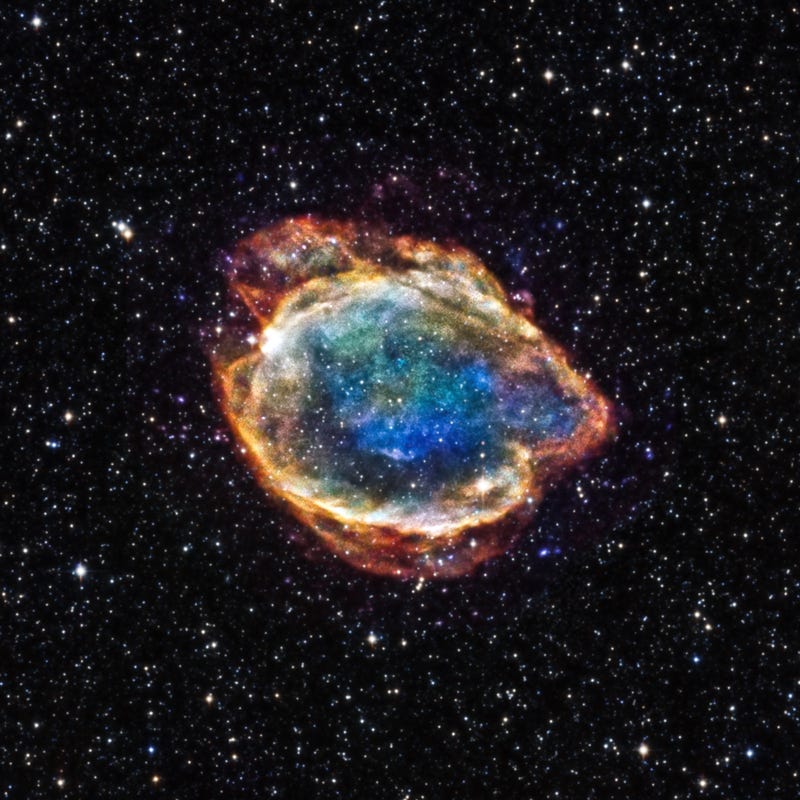
Every single thing we encounter on Earth exists because, at one point, its atoms were processed through stars. This week Sarah Pearson took us through a tour of the origin of the elements, from hydrogen and helium, through every element in our bodies and the world around us. The real stars of tonight's lecture were supernovae, the beautiful explosions that both produce and distribute elements throughout the universe.

Shortly after the Big Bang, the universe consisted almost entirely of hydrogen and helium. At this point, we had a long way to go before enough elements were produced to give rise to the rich chemistry that governs life here on Earth. As Sarah explained, within the first stars, and in every star since then, nuclear fusion smashed together hydrogen and helium to form increasingly heavier, and more complicated elements. However, these elements would still be trapped within the cores of stars if it not were for a weird quirk of physics. As Sarah showed, once iron is produced within stars, they enters its death throws; quickly collapsing then suddenly exploding with tremendous energy....

Sarah showed images observations of supernova remnants, the hot gas left over after a supernova explosion. This gas expands and mixes with its surroundings, carrying elements produced inside the star with it. Over time, after many explosions, these elements mix throughout a galaxy, eventually ending up inside new stars where the cycle continues.


After the talk, we discussed recent updates to the upcoming James Webb Space Telescope (JWST). Lauren Corlies gave an overview of the instrumentation of the JWST, the replacement to the Hubble Space Telescope. Andrew Emerick talked about the science goals of this upcoming mission, from observing exoplanets in the Milky Way to the first stars and galaxies formed near the beginning of the Universe.

-- Andrew Emerick (graduate student)