Showing posts with label Supernovae. Show all posts

Tuesday, June 14, 2016

May 20 - La Escalera de Distancias Cósmicas


Our last public outreach night of the spring semester was a special version, as the whole event was conducted in Spanish. Although the event was targeted to the Spanish-speaking community of New York, the audience was mixed, as some non-Spanish speaking attendees chose to skip the talk and head directly to the roof top to observe the sky. We were lucky enough that night to have bright Jupiter and the Moon easily accessible from our telescopes.


José Zorrilla, a graduate student in the Astronomy Department at Columbia University, gave a talk titled “La Escalera de Distancias Cósmicas” (“The Cosmic Distances Ladder”), in which he explained some of the ideas and methods used in astronomy to determine distances across the universe. He began by explaining the concept of trigonometric parallax and how astronomers use it to measure the distance to nearby stars. He then talked about astronomical objects known as standard candles, such as supernovae and some types of variable stars. These, he explained, can be used to measure much greater distances, to galaxies in the vicinity of the Milky Way and beyond. Lastly, José talked about redshift as a way to measure distances to the most faraway galaxies in the universe. To put it all together, José explained how the different methods rely upon others to determine distances to the most remote objects we know in the universe, hence the term “ladder”. He also pointed out that the discovery of new distance measuring methods has led the revolution in our understanding of the universe and its true extent.

-- Alejandro Núñez (graduate student)

Wednesday, May 18, 2016

Apr 29 - Explosive Origins of Our Elements


Every single thing we encounter on Earth exists because, at one point, its atoms were processed through stars. This week Sarah Pearson took us through a tour of the origin of the elements, from hydrogen and helium, through every element in our bodies and the world around us. The real stars of tonight's lecture were supernovae, the beautiful explosions that both produce and distribute elements throughout the universe.

Shortly after the Big Bang, the universe consisted almost entirely of hydrogen and helium. At this point, we had a long way to go before enough elements were produced to give rise to the rich chemistry that governs life here on Earth. As Sarah explained, within the first stars, and in every star since then, nuclear fusion smashed together hydrogen and helium to form increasingly heavier, and more complicated elements. However, these elements would still be trapped within the cores of stars if it not were for a weird quirk of physics. As Sarah showed, once iron is produced within stars, they enters its death throws; quickly collapsing then suddenly exploding with tremendous energy....

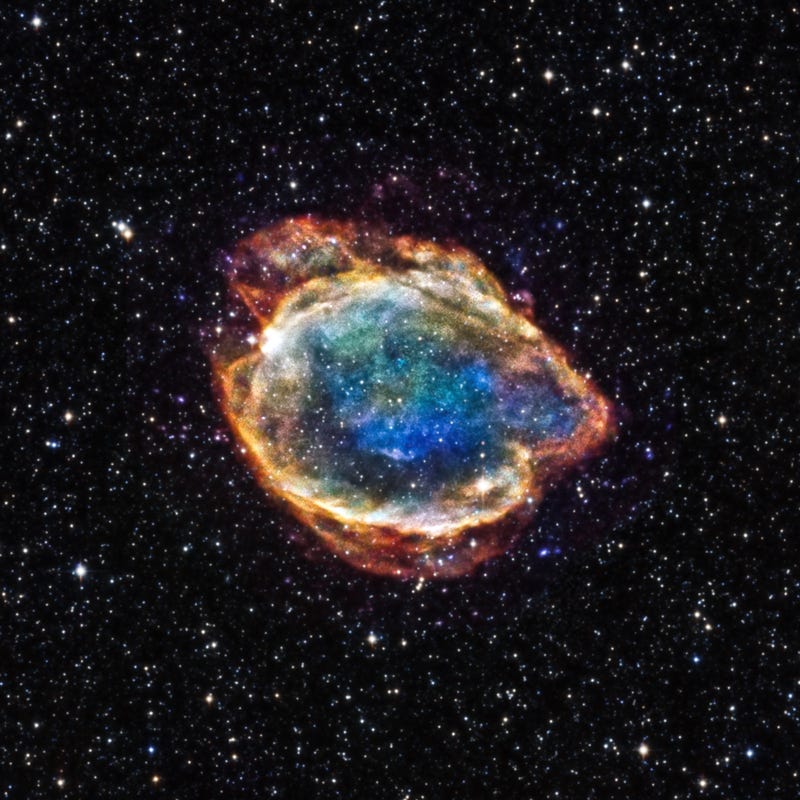
Sarah showed images observations of supernova remnants, the hot gas left over after a supernova explosion. This gas expands and mixes with its surroundings, carrying elements produced inside the star with it. Over time, after many explosions, these elements mix throughout a galaxy, eventually ending up inside new stars where the cycle continues.


After the talk, we discussed recent updates to the upcoming James Webb Space Telescope (JWST). Lauren Corlies gave an overview of the instrumentation of the JWST, the replacement to the Hubble Space Telescope. Andrew Emerick talked about the science goals of this upcoming mission, from observing exoplanets in the Milky Way to the first stars and galaxies formed near the beginning of the Universe.

-- Andrew Emerick (graduate student)

Friday, October 30, 2015

Oct 16: Observing Variable Stars


Stella Kafka, Director of the American Association of Variable Star Observers (AAVSO), gave a dynamic talk on variable stars, terming them "the good, the bad, and the explosive". Good variable stars show very regular periodic signals that can be directly tied to physical processes - like stellar pulsations. Bad variable stars have messier variability, such as star spots rotating in and out of view as they evolve. Finally, some stars explode and suddenly brighten by orders of magnitude. They may explode once (supernovae) or experience smaller surface eruptions (classical novae).


The AAVSO has been collecting data on variable stars for over a hundred years since its founding at the Harvard Observatory in 1911. They are an organization of amateurs who observe variable stars, and their data contributes to professional astronomical research. Even interested members of the public without telescopes can contribute (website).


After Stella's talk, undergraduate Tanay Bhandarkar showed recent pictures of Pluto from NASA's New Horizons mission. Post-doc Shy Genel presented movies on the 3D wall. The team on the roof, led by graduate student Yong Zheng, were mostly thwarted by clouds, but managed to briefly observe the Pleiades.

-- Steph Douglas (graduate student)

Thursday, March 6, 2014

February 21: Neutral Particle Power


Every second trillions of neutrinos cross our bodies without ever noticing. Graduate student Jia Liu guided the audience through the mysteries of these tiny particles that have puzzled scientists for decades. Neutrinos were suggested by the famous physicist Wolfgang Pauli to account for the missing energy, when a neutron splits into a proton and an electron (a process known as beta decay).

Neutrinos are abundant in nature and are produced through various processes. They are produced in the core of the stars when light nuclei merge to form heavier elements, in nuclear plants when the opposite process (heavier nuclei are divided into lighter) takes place to provide energy, in supernovae explosions and even when energetic particles from outer space interact with the atmosphere.

Neutrinos come in three varieties, have low mass and interact very weakly with matter, making their detection challenging. Next, Jia showed some of the cutting-edge operating detectors like IceCube in the South pole, ANTARES under the Mediterranean sea and Super-K in Japan, that trace neutrinos from astrophysical sources.

Finally, Jia discussed some intriguing potential (fiction-like) uses of neutrinos in the future, as proposed in serious scientific journals. Some of them included the destruction on nuclear weapons, the communication with extraterrestrial civilizations and equity trading.

After the lecture, the audience had the chance to view 3D movies of the universe on the 13th floor, to participate in roof tours and hear more about neutrino flavors from graduate student Andrew Weis. Later, as the sky cleared out and observing was possible, the few who stayed had the chance to look at Jupiter, the Orion Nebula as well as the new Supernova 2014J in nearby galaxy M82, which is the closest type-Ia supernova discovered in the past 42 years.

We hope to see you in our next event, which will entail an exciting collaboration with the neuroscience outreach group!

--Maria Charisi (graduate student)

Thursday, December 5, 2013

November 22: From the Ashes of Cosmic Explosions...


How did we get here?  Jeremiah Murphy, a new faculty member at Florida State University, shared with us the astronomical answer to this age-old question.  Or, rather, he answered the question of how his dog got here.  He traced the history of the elements in his dog's body, starting with the hydrogen and helium that formed in the Big Bang.  Those lighter elements were fused into heavier elements in the cores of massive stars and in supernovae, the explosions of those same stars.  Supernovae occur when iron builds up in the core of a massive star until that iron cannot support its own weight. Jeremiah showed us the results of his simulations showing how the iron core collapses, producing a blast wave and a wave of sub-atomic particles called neutrinos.  Those two waves tear the star apart in under a second.  The energy produced allows the production of all the elements up to uranium.


Although it was cloudy, graduate student volunteers Jeff Andrews and Andrew Emerick gave tours of our rooftop observatory after the lecture.  Other attendees visited the 3D wall, where graduate student Yuan Li showed off 3D movies about the universe.  In the lecture hall, Summer Ash and graduate students Jingjing Chen and myself answered questions and collected survey results about the night's events.  I also gave a short slideshow on supernovae that were seen on Earth and recorded in historical documents.

--Steph Douglas (graduate student)

Monday, April 29, 2013

April 19: Extragalactic FM


On Friday, April 19th, Ph.D. candidate Destry Saul shared with us the wonders of the Universe as seen  in the radio portion of the electromagnetic spectrum. He introduced the audience to some of his favorite radio images taken with his favorite radio telescopes. Radio telescopes can either be single dish (like Arecibo or Parkes) or arrays (like the VLA or the VLBA). Objects that emit in the radio include galaxies, supernova remnants, and pulsars. Destry's favorite objects include the closest and most powerful radio source, Cygnus A, and the brightest radio supernova remnant, Casseopeia A.

Unfortunately, the skies were quite cloudy, so observing was replaced by tours of our rooftop observatory given by graduate students Adrian Price-Whelan and Steph Douglas. Audience members were also treated to a guided viewing of our 3D Wall by undergraduate Gladys Velez-Caicedo, and a discussion of the other end of the electromagnetic spectrum, X-ray astronomy, by graduate student Yuan Li.

We hope to see you at our next event on May 3rd.

--Summer Ash (Director of Outreach)

Tuesday, March 26, 2013

March 15: Cosmic Candles


Last week, Ashley Pagnotta, a post-doc at the American Museum of Natural History, gave a talk entitled, "Supernovae: Cosmic Candles of the Universe." Ashely's research focuses on stellar explosions known as supernovae which occur toward the end of a star's life. Different phenomena give rise to different types of supernovae and by understanding the nature of these explosions, astronomers can better constrain the parameters that help us describe the behavior of our Universe. 

It was less than a hundred years ago that astronomers even discovered that the Universe wasn't static, i.e., "standing still". Using the doppler effect to measure the speed at which galaxies were moving away from Earth and cepheid variable stars to measure distance, Edwin Hubble made a plot of of these two variables and discovered that the farther a galaxy was from Earth, the faster it was moving a way from us. Today, we call this plot the Hubble Diagram in his honor and continue to update it as we make better and better measurements. You can make you own Hubble Diagram using data from the Sloan Digital Sky Survey here

While Hubble's work showed that Universe is expanding, it said nothing about the future of this expansion. To investigate this, two teams of astronomers proposed using Type 1a supernovae to probe the Universe out to greater distances, and therefore farther back in time. They used Type 1a supernovae instead of cepheid variables as these supernovae have a characteristic explosion that allows astronomers to use them as a standard candle of sorts; astronomers know how bright they are at a given distance so they can observe them at various distances and extrapolate their true distance based on their observed brightness. Both teams ended up discovering that the expansion of the Universe was *accelerating*, giving rise to the theory of dark energy, and as a result we awarded the Nobel Prize for Physics in 2011

Ashely went on to explain how studying how Type 1a supernovae form in more detail can help astronomers minimize errors associated with their distance measurements and thereby improve our understanding of dark energy. You can view the slides from Ashely's talk here

Unfortunately, the skies were cloudy again so after the lecture, the 120+ audience members toured the roof with the help of graduate student Adrian Price-Whelan, viewed 3D movies with undergraduate Jose Montelongo, and learned about Comet PANSTARRS with Director of Outreach, Summer Ash, and graduate student Yong Zheng. 

Please come see us on April 5th when graduate student, Ximena Fernandez, will present highlights from lesser known space telescopes that are providing astronomers with great glimpses of the Universe. 

--Summer Ash (Director of Outreach)

Tuesday, November 6, 2012

October 19: The Universe is My Lab


On October 19th, graduate student, Or Graur from the American Museum of Natural History, addressed a question always asked of astronomers - "What exactly do you do?"  Or walked an audience of 70 people through the process taken to publish his most recent work on supernovae - from forming the hypothesis to testing it with telescopes and equipment to finally creating the scientific plot of merit.  It was a great inside look at how we practice astronomy today.

Unfortunately, the weather was less than stellar and roof observing was not possible.  However, our 3D movie wall provided entertainment after the talk.

--Lauren

Saturday, December 24, 2011

December 16: How I Discovered A Supernova

We had a wonderful turnout for Caroline Moore's talk "How I Discovered a Supernova." Caroline gave an enthusiastic and informative talk that covered all aspects of her amazing discovery of SN2008ha. Caroline primed her audience with the background on stellar evolution needed to understand why supernova form and emphasized what types of stars ultimately end as supernova (not all do!). She mentioned some debate that has surrounded the classification of the SN2008ha -- indeed, SN2008ha has a very low luminosity and determining its class has required followup work using a wide range of telescopes to understand its nature. Caroline described the process of "blinking" frames that she used to find SN2008ha. There were many children present in the audience, and in the end she let them try to find SN2008ha by blinking the frames and letting them find the supernova. Indeed, this proved more difficult than expected but also got the point across that this kind of work requires extreme meticulousness. After the talk, Caroline answered a range of questions and this is when we learned that she also discovered another supernova recently: SN2009he!

Unfortunately, the sky was cloudy but around 40 people still went up to the rooftop observatory for a tour, led by grad student Josh Schroeder and assisted by Jeff Andrews, Curtis Cooper, Ian Allen, and Miao Li. Grad student Jana Grcevich led 3D visual simulations up on the 13th floor of Pupin Hall. In the lecture hall after the talk, undergrad Emir Karamehmetoglu and I showed the video "Cosmic Collisions" and this led to an open discussion on a variety of astronomy topics. Thanks to all the volunteers and the 170 people who came out for the night!

--Allyson