Tuesday, February 9, 2016
Jan 29 - BLAST!
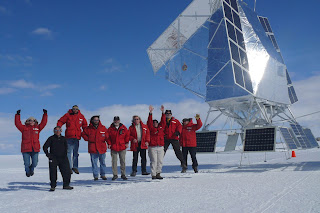
Our first event of the year didn't exactly go as planned as our scheduled screening of BLAST! was plagued by technical difficulties. On the other hand, a thoroughly overcast day miraculous cleared up right as our stargazing began so what might have otherwise been a disappointing night turned into one of the better observing sessions we've had this winter! Led by graduate student Yong Zheng, astronomers on the roof had telescopes pointed at the Orion Nebula, Jupiter and the Galilean moons, and the Pleiades star cluster. On the indoor side, undergraduate Gladys Velez-Caicedo, ran our 3D Wall for a packed house.
For those interested in seeing what actually happened with the BLAST experiment, we hope you'll give us another chance and come see us over the summer for our Film & Stargazing series. We will reschedule our screening of the film then (and will bring every back-up system ever invented).
Thanks to everyone who came out for their incredible patience throughout the evening.
-- Summer (Director of Outreach)
Labels:
3D Wall,
Graduate Student,
Jupiter,
Observing,
orion,
orion nebula,
Pleiades,
Rutherfurd Observatory
Wednesday, December 16, 2015
Dec 4 - On the Care and Feeding of Black Holes
Aleksey Generozov, a 4th year PhD student in the astronomy department, introduced us to the majesty of black holes. Black holes are regions in space-time, where gravity is so strong that nothing (particles or even light) can escape from inside; we could make a black hole if we squeezed the entire earth into the size of our fingernails.
Aleksey next described the discovery of a supermassive black hole at the center of our galaxy, the Milky Way. Observing the orbits of stars very close to the galactic center, with very high precision, astronomers concluded that an object very massive (with mass a few million times the mass of the sun) and very compact (that would fit in a sphere with radius smaller than the radius of our solar system) must be hidden in the galactic center. The only feasible explanation was a huge black hole. These days, we are actually on the verge of seeing the radius of the black hole (the event horizon), with a network of radio telescopes positioned around the globe.
And although the black hole at the center of our galaxy is relatively quiet, this is not the case for every galaxy. In the '60s, astronomers discovered some very bright radio sources, equally bright as some nearby stars, which they named quasars (quasi-stars). Later, when the size and distance of these objects were measured, it was realized that the enormous amount of energy is produced when gas falls onto a supermassive black holes at the center of a very distant galaxy. The gas is brought to the central black holes, when two galaxies collide. This also explains why our own supermassive black hole is quiet; It's starving! However, there is some evidence from observations of very high energy photons, that our own black hole had a more spectacular past. The talk concluded with Aleksey and the audience singing along "twinkle-twinkle quasi-star".
After the lecture, the audience had the chance to hear about the K2 mission, which is the second phase of NASA's Kepler space telescope, lead by graduate student Stephanie Douglas. Moreover, they had a chance to further explore galaxies and black holes by watching 3D movies, guided by undergraduate Briley Lewis. The clear sky and the mild temperature gave us a wonderful opportunity for stargazing on Pupin's roof with the help of Adrian Price-Whelan, Emily Stanford, Daniel De Felippis, Rasmi Elasmar, and Richard H Nederlander. Attendees were treated to views of the Andromeda Galaxy, the Pleiades star cluster, and the Red Giant Betelgeuse.
-- Maria Charisi (graduate student)
Tuesday, December 1, 2015
Nov 13 - The Dark Matter of Ghost Galaxies
Multiple galaxies are reported missing from around the Milky Way. The cops have no leads on where to find the missing satellite galaxies. The government is keeping tight lipped. Only one investigator, Jana Grcevich, has any clues to offer on where they have gone.
Dwarf galaxies hold the secrets, and dark matter is the prime suspect. Looking at the stars in these galaxies we can work out that there's less dark matter in their centers than we expect. After deep investigation (and at least one car chase) Jana believes that this can explain why we're not seeing these satellite galaxies, and what their absence can tell us about dark matter and our galaxy.
As well as this packed talk, witnesses enjoyed some hair raising on stage demonstrations of what happens when you crash the most massive galaxies in the universe together by Zephyr Penoyre. They we're able to explore the cosmos even deeper with Shy Genel leading them through a 3D exploration of the hearts of stars and the far edges of the galaxy.
And those who braved the cold and the clouds were rewarded with some stunning views of the Pleiades, Double Cluster, Capella and many others, as our brave team of student volunteers ducked and dove between the clouds, under the steady guiding hand of Steven Mohammed.
-- Zephyr Penoyre (graduate student)
Labels:
3D Wall,
capella,
Dark Matter,
double cluster,
dwarf galaxies,
Galaxies,
Observing,
Pleiades
Thursday, November 5, 2015
Oct 30 - Re-tuning the Hubble Diagram
Our lecture this past Friday was by Columbia Astronomy graduate student David Hendel entitled "Re-tuning the Hubble Diagram". David used stunning Hubble images to demonstrate the diversity in galaxy shapes and discuss how astronomers classify them. He then went on to discuss why this organization, the Hubble Tuning Fork, can be misleading and how galaxies can be transformed from one classification to another.
After the lecture, some stayed for a lecture on our Local Group by Lauren Corlies and Mihir Kulkarni and Richard Nederlander ran the 3D wall and a discussion on stellar structure. Up on the roof, the weather was great for observing. Yong Zheng led volunteers Emily Sandford, Alex Teachey, Aleksey Generozov and Zephyr Penoyre in pointing the telescopes at double star Albireo, the Double Cluster, and the elusive Andromeda Galaxy.
Overall, it was a great way to kick off the Halloween weekend.
-- Lauren Corlies (graduate student)
Friday, October 30, 2015
Oct 16: Observing Variable Stars
Stella Kafka, Director of the American Association of Variable Star Observers (AAVSO), gave a dynamic talk on variable stars, terming them "the good, the bad, and the explosive". Good variable stars show very regular periodic signals that can be directly tied to physical processes - like stellar pulsations. Bad variable stars have messier variability, such as star spots rotating in and out of view as they evolve. Finally, some stars explode and suddenly brighten by orders of magnitude. They may explode once (supernovae) or experience smaller surface eruptions (classical novae).
The AAVSO has been collecting data on variable stars for over a hundred years since its founding at the Harvard Observatory in 1911. They are an organization of amateurs who observe variable stars, and their data contributes to professional astronomical research. Even interested members of the public without telescopes can contribute (website).
After Stella's talk, undergraduate Tanay Bhandarkar showed recent pictures of Pluto from NASA's New Horizons mission. Post-doc Shy Genel presented movies on the 3D wall. The team on the roof, led by graduate student Yong Zheng, were mostly thwarted by clouds, but managed to briefly observe the Pleiades.
-- Steph Douglas (graduate student)
Labels:
3D Wall,
AAVSO,
citizen science,
novae,
Observing,
Supernovae,
variable stars
Friday, October 16, 2015
Oct 2: The Glorious Past of Our Monster Black Hole
Last week, physics graduate student and NASA fellow, Shuo Zhang, introduced us to the monstrous black hole in the center of our galaxy. It is well established that every massive galaxy hosts a supermassive black hole in its center and Milky Way is not an exception. Astronomers analyzing the orbits of stars in the galactic center, enabled by advancements in observing technology, realized that the only feasible scenario for the dark object in the center is the galaxy is a black hole with mass of a few million times the mass of the sun.
The black hole is known as Sagittarius A-star (SgrA*), since it is located near the border of the constellations Sagittarius and Scorpius. Being the closest supermassive black hole we can observe, SgrA* is of great astronomical interest. But is it a typical black hole? SgrA*, is one of the quietest supermassive black holes among all the nearby galaxies. However, that wasn't always the case. Recently, the Fermi Gamma-ray Space Telescope discovered a bubble of gamma-rays surrounding our galaxy, which indicate that 2 million years ago, the black hole was very active, swallowing gas and expelling in at large distances.
Shuo also mentioned her own work observing the black hole at the center of the galaxy with an X-ray telescope called NuSTAR (a NASA mission, in which Shuo's research group here at Columbia was a major contributor). Shuo observes sporadic X-ray flares, which last for a few seconds. During these flares the black hole becomes hundreds of times brighter and then returns to its quiet state. The origin of the flares is still unknown and it has been suggested that we observe the heated remnants of an asteroid that was ripped apart by SgrA*.
Unfortunately, the weather did not cooperate to allow stargazing. Whoever stayed after the lecture had a chance to see 3D movies of the galaxy lead by undergraduate student Richard Nederlander, or hear a short presentation by graduate student Emily Sanford, about the exciting discovery of water on the surface of Mars.
-- Maria Charisi (graduate student)
Tuesday, September 29, 2015
Sept 18: Hubble IMAX
The Hubble Space Telescope has been humanity's eye on the universe for over 25 years now. In honor of the observatory's birthday this year, last Friday we screened the IMAX film "Hubble" at Columbia. We were moved to a smaller room this year, but one of our biggest crowds ever came out to celebrate Hubble with us.
Hubble was launched in 1990, but was partly disabled until a 1993 servicing mission installed a contact lens (of sorts) that allowed Hubble to reach its full potential. Though the movie included clips from the launch and first servicing mission, it focused on the final shuttle mission to Hubble in 2009 (there were four servicing missions with five shuttle visits in total, not including launch). We watched as the astronauts, including now Columbia Engineering Professor Mike Massimino, persevered through technical and mechanical challenges to replace important instruments and stabilizing gyroscopes. These repairs enabled Hubble to continue its crucial role of observing our universe.
Another highlight of the film was the animated fly through of the iconic Hubble image of the Orion Nebula. The Hubble data on Orion is so detailed that scientists at the Space Telescope Science Institute and the National Center for Supercomputing Applications were able to reconstruct the Nebula in 3D. Although we couldn't show the 3D version, flying through the brightly colored nebula and zooming in to see the gaseous disks around infant stars took everyone's breath away.
After the movie, we showed a simulated clip of the Andromeda Galaxy colliding with our own (based on Hubble data), along with a cool solar system model built in the Black Rock Desert. On the roof, graduate student Steven Mohammed and four other volunteers who showed off the Andromeda Galaxy and the Ring Nebula. And when one of our 3D projectors on the 13th floor crashed, undergraduate Briley Lewis and grad student Zephyr Peyore thought fast and created a new presentation to educate visitors.
-- Stephanie Douglas (graduate student)
Labels:
Andromeda,
Astronauts,
Film,
Galaxies,
Hubble,
Mike Massimino,
movie,
NASA,
Observing,
orion nebula,
Ring Nebula,
Solar System,
video
Subscribe to:
Posts (Atom)


