Monday, October 22, 2018
October 19th - Vacation guide to the Solar System
Have you planned your next vacation yet? For those of you interested in winter sports, the onset of November means you can finally start hitting the slopes at the variety of ski resorts within the US! But, why not kick things up a notch? Want to get bigger air so you can practice back-to-back frontside 1080s and rival the likes of Chloe Kim? Then head on out to Pluto!
If you're not a big fan of snow, fear not! Jana Grcevich, our speaker on Friday, stepped us through the top 10 vacation spots within the Solar System. From taking in the breathtaking views of Saturn's haxagonal cloud pattern around its north pole to taking a leisurely blimp ride through the upper atmosphere of Venus; there is bound to be something everyone would enjoy! As Jana explained, we are at the dawn of a space tourism revolution, and although there are plenty of hurdles to overcome (such as how to protect ourselves from the lethal radiation doses we would be exposed to on such trips), it's fun to daydream about touring the Solar System one day.
"But I want to go right now!" Yeah, I hear ya! Fortunately Jana gave a couple of options we could all pursue starting now! The Intergalactic Travel Bureau, a group that Jana is a part of, has put out a virtual reality app that allows smartphone users to embark on "space vacations". So go get yourself a cardboard VR viewer, download the app, and start exploring! Alternatively, Jana briefly talked about a book she and Olivia Koski co-authored: "Vacation Guide to the Solar System", a fun book for readers of all ages.
After the talk, Jana answered many fun questions from the audience and had awesome Solar System post cards to pass out. The audience then headed up to the roof for some star gazing but were instead greeted with mostly cloudy skies. Nevertheless, views from atop the roof are always a nice treat!
-- Jorge Cortes (graduate student)
Saturday, October 6, 2018
October 5th - Slooh your way to the stars
What's in an acronym? Paige Godfrey, Slooh's research director, gave us an overview of the services offered by this online observatory. As of today, Slooh provides access to six telescopes. The majority, 5, are located in the Canary Islands. These include their largest instrument with an aperture of 0.5 meters (20 inch). Another telescope in Chile gives access to the many interesting objects located in the southern sky, and a solar scope equipped with a narrow band H-alpha filter allows observations of the solar chromosphere. By locating their observatories under some of the darkest skies, they facilitate access to high quality observations to individuals who would live in areas that suffer from light pollution (all cities).
Individuals can access the data obtained by the cameras attached to Slooh's telescopes. Paige showed some examples of work done by members of their community, from processed images, mosaics and gifs, to discoveries of new comets. Since the processing of astronomical data can have a rather steep learning curve, they're developing materials to make it easy for anyone to get started.
Paige explained how these resources allow schools to incorporate observational astronomy into their curriculum, and they're launching a specific program, AstroLab, with the support of the National Science Foundation.
As an illustrative example of how Astronomy can help answer some of the most fundamental questions we've asked ourselves through history, Paige introduced the use of Drake's equation, a way to quantify the number of communicating civilizations in a given volume, and applied it to the set of stars visible in a typical image taken with one of Slooh's telescopes. Turns out vulcanians may be out there for real!
-- Jose Zorrilla (graduate student)
Monday, September 24, 2018
September 21 - Clocks of the Universe
Imagine that half of your wedding guests show up at the venue a month before the event because the government’s decision to add a month to this year’s calendar did not reach them. Turns out that such a scenario could not be completely ruled out in ancient Rome. Mihir Kulkarni, our speaker on Friday, opened our eyes to how the way we measure and keep track of time has evolved through history and how different cultures use different systems.
Until recently, no man-made device could match the regularity of celestial movements. As a result, we used the Earth’s spin, its rotation around the Sun and the Moon’s movements to measure time. These measurements became encoded in the calendars that helped regulate human activity, from seeding to religious festivities. Small differences between the actual movement of celestial bodies and that captured by calendars add to the point where they become noticeable and sometimes, disruptive. Such disagreements were often dealt with through ad-hoc adjustments, but ultimately they inspired calendar refinements based on more accurate astronomical models. This way, we learned about hard-to-measure phenomena such as the precession of the Earth’s rotation axis. As the axis wobbles not unlike that of a spinning top, the closest star to the north pole -called the North Star-, changes. This shift occurs on timescales of thousands of years, long compared with a person’s lifespan but measurable through history.
Finally, minute perturbations and secular changes to the Earth’s movement relative to the rest of the universe pose a fundamental limit to the precision with which we can measure time. To beat these limitations, our current time standards do not rely on astronomical calculations anymore, but that has not removed all implementation challenges, as the “Unix 2038 year” problem illustrates.
After the talk, Mihir answered many insightful questions from the audience. You can also find a detailed summary of the talk by Steven Fertig, of the Amateur Astronomers Association of New York, here.
Clouds prevented us from star gazing, but we had the opportunity of touring the Rutherfurd’s observatory facilities lead by Daniel and Matthew while Douglas discussed some counter-intuitive properties of black holes with the support of animations in our 3D wall.
-- Jose Zorrilla (graduate student)
Monday, April 16, 2018
April 6 - Signal to Noise
We have a special joint event with the Wallach Art Gallery on May 6th. The event, titled “Signal to Noise”, is an interdisciplinary salon that discuss and exhibit the significance and nuisance of sounds and noise in our daily lives.
Andrea Derdzinski, a fourth-year NSF graduate fellow, gives her lecture on gravitational waves. She first introduces the electromagnetic spectra and explains how astronomers use them to study various celestials objects in the universe. Then she focuses on the recently discovered gravitational-wave events, including the first finding of the 30-solar-mass black hole mergers and the recently discovered neutron-star merger.
After Andrea’s lecture, Ariana van Gelder, who is a Ph.D. candidate at CUNY and an experimental musician, make her performance by improvising experimental rhythm as inspired by the random sounds in the lecture hall. Then, Ariana together with her artistic fellows, Emmy Cathedral, Constance DeJong, Ray Ferreira, Dominika Ksel, and Sarada Rauch, exhibit a light and sound salon in the library and stairwell on the 14th floor of Pupin. The salon features how signals (i.e., light and sound) intervene and enhance our daily experiences with the nature and society.
-- Yong Zheng (graduate student)
Andrea Derdzinski, a fourth-year NSF graduate fellow, gives her lecture on gravitational waves. She first introduces the electromagnetic spectra and explains how astronomers use them to study various celestials objects in the universe. Then she focuses on the recently discovered gravitational-wave events, including the first finding of the 30-solar-mass black hole mergers and the recently discovered neutron-star merger.
After Andrea’s lecture, Ariana van Gelder, who is a Ph.D. candidate at CUNY and an experimental musician, make her performance by improvising experimental rhythm as inspired by the random sounds in the lecture hall. Then, Ariana together with her artistic fellows, Emmy Cathedral, Constance DeJong, Ray Ferreira, Dominika Ksel, and Sarada Rauch, exhibit a light and sound salon in the library and stairwell on the 14th floor of Pupin. The salon features how signals (i.e., light and sound) intervene and enhance our daily experiences with the nature and society.
-- Yong Zheng (graduate student)
Friday, March 16, 2018
March 9 - Alien Weather
Our speaker this week was Statia Cook, a Columbia Teaching Fellow and a Research Associate at the American Museum of Natural History. She is an observational astrophysicist whose research focuses on studies of the weather and climate of other planets, especially the giant planets in the outer Solar System.
Statia started by orienting us to some of the key differences between weather on the Earth and on the "gas giants" (Jupiter and Saturn) and "ice giants" (Uranus and Neptune). On the Earth, the atmosphere is very thin compared the diameter of the planet -- similar to a few layers of cling wrap on a basketball. The giant planets, by contrast, are mostly (or entirely) atmosphere, although their density and temperatures vary with depth to such a degree that the same gasses may behave differently at different layers. In addition, the Earth's weather is driven almost entirely by energy from the Sun, whereas the giant planets still retain a large amount of heat from their formation. The release of that energy can be as important as the Sun to their climate. Finally, on Earth almost all clouds are water vapor, while the various colors seen in the giant planets trace clouds with different compositions including methane and ammonia.
Next, we heard about perhaps the best know extraterrestrial weather pattern: Jupiter' Great Red Spot, a persistent storm larger than the Earth that has existed for at least 180 and possibly more than 350 years. This vortex is accompanied by many other short-lived systems in Jupiter's atmosphere, with colors varying from white to pink to red. Neptune also had a giant storm, dubbed the Great Dark Spot, although it vanished in the five years between its discovery by the Voyager 2 spacecraft and observations by the Hubble Space Telescope five years later.
Finally, Statia told us about some of her own research which include detailed maps of Neptune using submillimeter radio interferometry, a pair of storms near Neptune's south pole that seemed to circle and merge together, amateur-inspired observations of a new Dark Spot on Neptune, and seasonal climate variation of the Ice Giants.
After the talk, Statia fielded questions, followed by a presentation by yours truly on the history of evidence for dark matter.
-- David Hendel (graduate student)
Statia started by orienting us to some of the key differences between weather on the Earth and on the "gas giants" (Jupiter and Saturn) and "ice giants" (Uranus and Neptune). On the Earth, the atmosphere is very thin compared the diameter of the planet -- similar to a few layers of cling wrap on a basketball. The giant planets, by contrast, are mostly (or entirely) atmosphere, although their density and temperatures vary with depth to such a degree that the same gasses may behave differently at different layers. In addition, the Earth's weather is driven almost entirely by energy from the Sun, whereas the giant planets still retain a large amount of heat from their formation. The release of that energy can be as important as the Sun to their climate. Finally, on Earth almost all clouds are water vapor, while the various colors seen in the giant planets trace clouds with different compositions including methane and ammonia.
Next, we heard about perhaps the best know extraterrestrial weather pattern: Jupiter' Great Red Spot, a persistent storm larger than the Earth that has existed for at least 180 and possibly more than 350 years. This vortex is accompanied by many other short-lived systems in Jupiter's atmosphere, with colors varying from white to pink to red. Neptune also had a giant storm, dubbed the Great Dark Spot, although it vanished in the five years between its discovery by the Voyager 2 spacecraft and observations by the Hubble Space Telescope five years later.
Finally, Statia told us about some of her own research which include detailed maps of Neptune using submillimeter radio interferometry, a pair of storms near Neptune's south pole that seemed to circle and merge together, amateur-inspired observations of a new Dark Spot on Neptune, and seasonal climate variation of the Ice Giants.
After the talk, Statia fielded questions, followed by a presentation by yours truly on the history of evidence for dark matter.
-- David Hendel (graduate student)
Sunday, February 25, 2018
February 23 - The LSST Revolution
Our speaker this week was Federica Bianco, a research scientist at both New York University's Center for Urban Science and Progress and their Center for Cosmology and Particle Physics. Her work focuses on transients - temporary changes in the sky. She is also the chair of the Large Synoptic Survey Telescope (LSST)'s Transients and Variable Stars Collaboration.
Federica's talk revolved around how the survey program of LSST will revolutionize our understanding of the changing universe, also known as time-domain astronomy. In particular, current studies tend to be at most two of wide (covering a large area of the sky), deep (observing faint objects) and fast (repeatedly observing the same place in quick succession). LSST is the first survey to attempt all three of these simultaneously by observing the entire Southern sky from its mountaintop in Chile, cataloging objects about 100 times fainter than current surveys with such a wide area, and imaging each patch of sky about once every three days -- with five different color filters.
LSST can achieve this due to its unique optical design that gives it an enormous field of view -- equal to the size of about 40 full moons -- and a 3,200 megapixel camera. This giant sensor will generate 15-20 terabytes of data a night, which will be immediately piped up to University of Illinois National Center for Supercomputing Applications in Urbana-Champaign, Illinois. There, the goal is to process each image and release in less than 60 seconds, including comparisons to previous data and generating an estimated 10 million science alerts per night. Just storing the 50-100 petabytes of data generated during its 10-year survey will be an immense challenge! Another amazing property of the LSST data is that it will be public immediately to all people in the US, so anyone interested can see what's happening in the sky almost in real time.
Federica also described the diverse science goals of LSST, which include understanding the nature of dark matter and characterization of dark energy; mapping the Milky Way; cataloging the Solar System; and exploring the changing sky. Many more details about LSST and its goals are available on its website.
After her talk, Federica answered questions in the lecture hall. Later, American Museum of Natural History fellow Betsy Hernandez gave a presentation on Active Galactic Nuclei while Columbia undergraduate Richard showed presentations on the 3D Wall and graduate students Daniel, Aleksey, and Adam gave tours of the observatory.
- David Hendel (graduate student)
Federica's talk revolved around how the survey program of LSST will revolutionize our understanding of the changing universe, also known as time-domain astronomy. In particular, current studies tend to be at most two of wide (covering a large area of the sky), deep (observing faint objects) and fast (repeatedly observing the same place in quick succession). LSST is the first survey to attempt all three of these simultaneously by observing the entire Southern sky from its mountaintop in Chile, cataloging objects about 100 times fainter than current surveys with such a wide area, and imaging each patch of sky about once every three days -- with five different color filters.
LSST can achieve this due to its unique optical design that gives it an enormous field of view -- equal to the size of about 40 full moons -- and a 3,200 megapixel camera. This giant sensor will generate 15-20 terabytes of data a night, which will be immediately piped up to University of Illinois National Center for Supercomputing Applications in Urbana-Champaign, Illinois. There, the goal is to process each image and release in less than 60 seconds, including comparisons to previous data and generating an estimated 10 million science alerts per night. Just storing the 50-100 petabytes of data generated during its 10-year survey will be an immense challenge! Another amazing property of the LSST data is that it will be public immediately to all people in the US, so anyone interested can see what's happening in the sky almost in real time.
Federica also described the diverse science goals of LSST, which include understanding the nature of dark matter and characterization of dark energy; mapping the Milky Way; cataloging the Solar System; and exploring the changing sky. Many more details about LSST and its goals are available on its website.
After her talk, Federica answered questions in the lecture hall. Later, American Museum of Natural History fellow Betsy Hernandez gave a presentation on Active Galactic Nuclei while Columbia undergraduate Richard showed presentations on the 3D Wall and graduate students Daniel, Aleksey, and Adam gave tours of the observatory.
- David Hendel (graduate student)
Tuesday, February 20, 2018
Feb 9th - The Zoomable Universe
Our speaker this week was Caleb Sharf, a research scientist at Columbia University and Director of its Astrobiology Center. Caleb is a prolific writer with contributions in publications such as The New Yorker, The New York Times, The Atlantic, Wired, and Scientific American in addition to highly regarded scientific journals. He has also written a textbook on exoplanets and three popular science books on various astronomical topics.
In his talk Caleb gave an overview of his latest book, The Zoomable Universe. In it, he explores phenomena that cross the vast range of physical scales, from the very largest we can observe (the entire diameter of the observable Universe, about 10^27 meters) to the smallest (the Planck scale, 10^-35 meters, where the fabric of spacetime stops obeying known laws of physics).
Caleb uses this vast range - a factor of one hundred trillion trillion trillion trillion trillion, of which the human scale is conveniently close to the middle - to illustrate the incredible diversity of phenomenon in the Universe. Starting with the mysterious dark energy and the large scale structure of dark matter that makes up the skeleton of galaxy formation, we zoomed in repeatedly to examine the Local Group of galaxies, the birth of a solar system, the surface of a planet, and continued down to our own DNA and eventually the structure of spacetime. An illustrated version of this journey can be found here.
After his talk, Caleb fielded questions in the lecture hall while Columbia undergraduate Richard showed presentations on the 3D Wall while graduate students Steven and Aaron gave tours of the observatory.
- David Hendel (graduate student)
Friday, November 17, 2017
Nov 10 - Going out in style: Nebulae at the end of a sun-like star’s life
Our speaker this week was Rudy Montez, an astrophysicist at the Chandra X-ray Center of the Smithsonian Astrophysical Observatory in Cambridge, MA. Rudy studies "planetary nebulae," the ghostly shells sloughed off by dying stars.
Rudy began by showing a gallery of beautiful Hubble Space Telescope photographs of planetary nebulae, explaining how the various colors tell us about the composition of the layers of each nebula. He noted that astronomers always expected planetary nebulae to be spherical, because they're believed to form as the outermost layers of a giant star expand away in all directions from the hot core.
But that's not what we see! Real-life nebulae display amazing, complex structure, including dumbbell-shaped bi-polar lobes. Rudy explained that the leading hypothesis to explain the formation of these lobes is that a donut-shaped ring of dust surrounding the dying star blocks the star's outer layers from expanding in certain directions, forcing them out at the opposite openings of the donut hole. The origins of this ring of dust are not quite clear, but they may be leftover debris from a pair of binary stars orbiting each other at the center of what will eventually be the nebula.
Rudy then discussed his area of particular expertise: X-ray observations of planetary nebulae from the Chandra space telescope, which give us a window onto the hottest, densest central regions. He showed beautiful composite images of Chandra, Hubble, and Spitzer data, which illuminate, respectively, the innermost, middle, and outermost regions of planetary nebulae. Three windows onto these extraordinary objects.
Friday, November 3, 2017
Oct 27 - Cosmic Mergers & Acquisitions: Mergers and Black Holes and the Growth of Galaxies
Our speaker this week was Dr. Jenny Greene, a Professor of Astrophysics at Princeton University.
Much of Jenny’s research concerns some of the most mind-boggling objects in the Universe: the supermassive black holes that exit at the centers of most galaxies. Millions to billions of times more massive than the Sun, these huge black holes are thought to play a crucial role in the development of galaxies.
Jenny began by reviewing what a black hole is: an incredibly dense object. She used the visual of compressing the Sun to the size of Jupiter, then the Earth, then Manhattan; as it gets smaller, the speed you need to escape its gravity gets larger and larger until it exceeds the speed of light. Since nothing moves faster than that, nothing can escape from a black hole.
Even though we can’t see black holes directly, Jenny showed us evidence of the supermassive black hole in the center of our Galaxy. Careful observations of the Galactic center reveal stars moving at phenomenal speeds. Measuring their positions over decades, astronomers can reconstruct their motions and show that they must be orbiting an incredibly dense but invisible object: a black hole.
Astronomers can’t directly see stars moving in other galaxies but their collective motions can be measured very precisely and it is clear that almost all galaxies require a supermassive black hole in their centers to explain these observations. Interestingly, it seems like the black holes’ sizes ‘know about’ the galaxy that they live in: the mass of the black hole can be predicted if the mass of the galaxy is known. How is this possible? Galaxies grow mostly by merging with other galaxies. This process brings in lots of new stars and gas. The gas both forms new stars and feeds the black hole, but as the black hole eats it forms an ‘accretion disk’ of very hot gas that heats up the remaining gas, eventually causing both star formation and its own growth to stop. In this way the size of the galaxy and the size of the black hole can become related.
If this picture is correct we should also see evidence of pairs of black holes, since each galaxy should have brought one along with it. Jenny described one way she and her students have been looking for these binary black holes. When they get close together, they will be orbiting each other at very high speeds — probably thousands of kilometers per second. The light from their accretion disks will be shifted to redder and bluer colors periodically due to the Doppler shift; if we can observe these color-changing black holes it would be good evidence in favor of our cosmological picture. So far the observations haven’t found anything but astronomers are still looking!
-- David Hendel (graduate student)
Friday, October 20, 2017
Sept 29 - Galactic Archeology
Our speaker this week was Keith Hawkins, a Simons Postdoctoral Fellow based in the astronomy department here at Columbia. Keith is a Galactic Archeologist. He searches for clues to the past of our galaxy, the Milky Way, similar to the way an archeologist seeks to learn about ancient civilizations and cultures.
Keith started by telling us about the "fossils" he uses to study the galaxy - stars! Stars are fossils in two ways. First, at the great distances involved on the scale of the Milky Way, we see stars not how they are but rather how they were up to hundreds of thousands of years ago, before humans even evolved on the Earth. This is because light moves at finite speed and needs time to reach us from the distant galaxy. Second, many types of stars live for hundreds of millions or billions of years and so their composition provides clues to what was going on at the time when they formed.
Next we learned about the tools used in galactic archeology. We heard about the methods used to measure distances, chemistries, and velocities of stars: parallax and spectra. Keith demonstrated parallax by having the audience hold up a finger and close each eye in sequence; the finger appears to move relative to the background. This is analogous to how astronomers measure distances, except observations taken on opposite sides of the Earth's orbit, 6 months apart, replace winking. The amount the star appears to move relates to its distance from us. Spectra, obtained by splitting a star's light and measuring how bright it is at different colors, contain a wealth of information. Dark bands in the rainbow are often visible. These bands correspond to light being absorbed by different elements in the star's atmosphere, so examining their pattern can tell an astronomer which and how much of the elements are in the star. The specific chemical signature of a star can pinpoint its place of birth or prove association with other stars. The bands in the spectrum may also be shifted to redder or bluer colors than normal; the direction and amount of shift is due to the Doppler effect and indicates the velocity of the star relative to us.
Keith finished his talk by describing his research's goal: a complete map of the Galaxy containing information on the positions, motions, and chemical content of millions of stars. He believes this "chemical cartography" will be key to deciphering the history of the Milky Way.
After the lecture and a lively question and answer session, undergraduate students Briley and Harrison showed 3D astronomy animations on the 13th floor while graduate students Steven, Aleksey and Haley pointed the Rutherford Observatory's telescopes at the Moon, Ring Nebula, and the double star system Albireo.
-- David Hendel (graduate student)
Labels:
3D Wall,
albiero,
Galaxies,
Milky Way,
Moon,
Observing,
post-doc,
Ring Nebula,
Rutherfurd Observatory
Friday, March 17, 2017
Mar 3 - Las Atmósferas Estelares
(This was our 3rd Annual Spanish-Language Lecture)
Turns out the Sun has an atmosphere, albeit very different from Earth’s. Alejandro Núñez, a graduate student at Columbia University, unveiled what is known about this gaseous envelope, layer by layer. He further described how a flotilla of space probes is helping scientists clarify some remaining mysteries by continuously gathering data from all angles and wavelengths. The most vexing of these unsolved questions is how the corona -the outer layer of the Sun’s atmosphere- can be hundreds of times hotter than the photosphere -its visible surface-, reaching temperatures in excess of a million degrees Celsius. While a detailed description of the heating mechanism still needs to be developed, it seems to be linked to the complex interaction between the Sun’s magnetic field and its atmospheric plasma.
Turns out the Sun is also a star. Thus, we can extrapolate what we learn about the Sun to other stars. As Alejandro explained, we need to do so with caution, for different stars can have diverse levels of magnetic activity. He illustrated this with a discussion on how the red dwarf at the core of the recently discovered multiple planetary system Trappist-1 seems to be much more active than our Sun, and the consequences that this could have for the habitability of the planets orbiting it.
This was the Spanish public lecture of this season, and the audience had the opportunity to stargaze at the Rutherford observatory on Pupin Laboratories’ roof after the talk. The night was cold and partly cloudy, but we managed to get a glimpse of some objects like the Moon and Mizar through some clearings.
-- Jose Zorilla (graduate student)
Tuesday, February 7, 2017
Feb 3 - Earth in Human Hands
On Friday night, author and astrobiologist David Grinspoon shared his new book, "Earth in Human Hands", with us. He claimed we are entering a new era on earth called the Anthropocene - the age of humanity. For better or worse, we are reshaping our planet, and we have the capability to be aware of and intentional about the changes we enact. He also told us about another species living 2.5 billion years ago that caused catastrophic climate change: cyanobacteria learned to generate O2 through photosynthesis, which changed the composition of atmosphere and that destroyed many other bacteria that thrived on the previously methane-rich atmosphere. He also made the distinction between inadvertent vs intentional changes in climate. For example, when we began driving cars on a wide scale, we didn't initially understand the environmental impact that would have. However, in the 70s, the world responding to ozone depletion by banning chlorofluorocarbons (CFCs), intentionally working to recover that protective layer between the Sun and us. Finally, Dr Grinspoon believes we can positively affect future climate, even beyond reversing the effects of humans on the climate - we could avert a future ice age, for example, since we know those happen periodically even when the Earth is left to its own devices.
After the lecture, Dr Grinspoon signed copies of his book, and then undergraduate Erin took the audience on a brief tour of the other planets in our solar system. Upstairs, undergraduates Richard and Cierra showed movies on the 3D wall, and graduate students Aleksey and Daniel led roof tours.
-- Stephanie Douglas (graduate student)
Labels:
3D Wall,
astrobiology,
book talk,
climate change,
david grinspoon,
earth,
Exoplanets,
Observatory Tour,
planets
Wednesday, January 25, 2017
Dec 16 - How to Hold a Dead Star in Your Hand
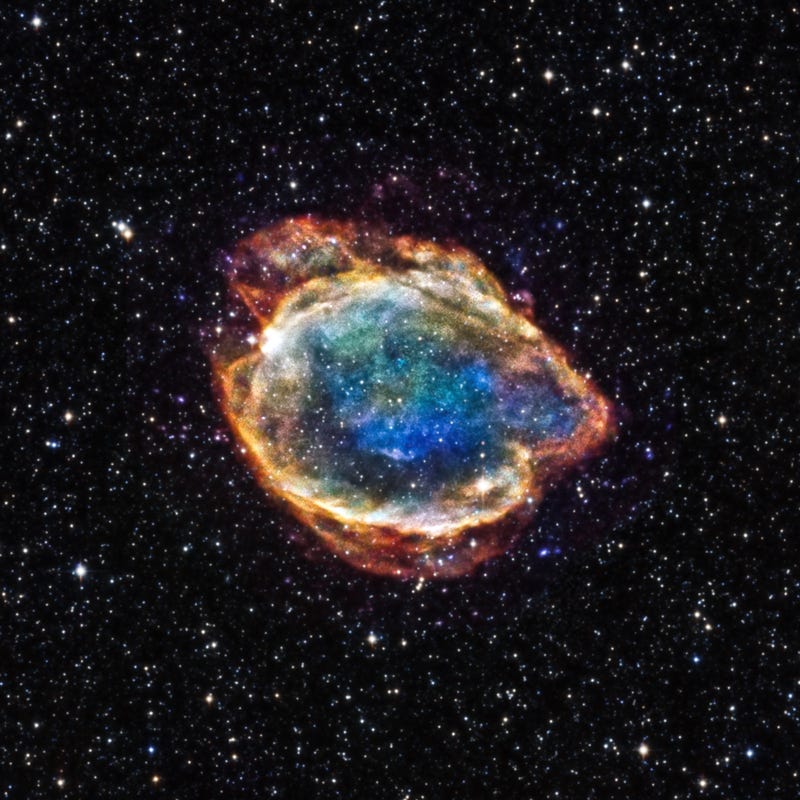
Our speaker, Kimberly Arcand, didn't come from an astronomy background. She began her science career as a biologist studying deer ticks, then moved into computer science before joining the Chandra X-ray Center (CXC), where she is now the visualization lead. Her job is to take the data and turn it into interesting and useful pictures. The data is beamed down from the telescope to NASA and then sent to the CXC as a lot of 1s and 0s. This is cleaned and assembled into black and white images; part of Kimberly's job is to determine how best to color these images to make them informative. Often, Chandra images are colored by the X-ray energy range or the dominant chemical/element.
Color has meaning. Kimberly spends part of her time studying responses to different color schemes, and choosing the right color scheme based on the audience for an image. Scientists think of blue as hottest, but culturally most people associate red with heat. Because Chandra images are important for outreach to the general public, her team picked red for the hottest parts of an image, rather than the blue that the scientists wanted.
Kimberly also told us about her work on visualizing the Cassiopeia A supernova remnant. Chandra (along with the Spitzer infrared telescope and Hubble Space Telescope) has observed this expanding shell of gas over many years, and you can actually see the gas moving outward in images taken several years apart. There is enough data that her team could use software borrowed from brain imaging to make the first 3D model of a dead star. She showed us a movie where we flew through the Cas A remnant. They also made a 3D printed model of the remnant - you can download the free file here if you want to hold your own dead star in your hand.
After the lecture, undergraduate Richard took us on a tour through all the scales of our universe, undergraduate Briley showed short astronomy movies on the 13th floor, and graduate students Alex and Aleksey led tours of the roof. Myself and graduate student Moiya also helped facilitate in the lecture hall.
-- Stephanie Douglas (graduate student)
Labels:
3d printing,
3D Wall,
cas a,
cassiopeia,
cassiopeia a,
Chandra,
supernova remnant,
X-ray
Monday, November 14, 2016
Nov 4 - The Cosmic Origins of the Chemicals of Life
We start, as perhaps all good talks should, with Genesis. Daniel Wolf Savin took us through the first three days of creation, from the light of our universes first stars to the formation of water, and maybe even life, on planets like our own. In the lab his team has recreated the chemical conditions of the first stars and used it to infer some of the evolution and distribution of the chemicals that form the building blocks of life. On the way he also gave us pearls of wisdom such as the best way to ensure a healthy supply of Belgian chocolate in your laboratory, and jokes that even he admitted were "good science but bad comedy".
After his stellar ("good science") talk we also heard from astronomy graduate student Moiya McTier, about how space affects all of our everyday lives. Meanwhile up on the roof we had clear skies, with Stephen Mohammed, Jorge Cortés, Danielle Rowland, and Emily Sandford guiding our telescopes to the Moon, Mars and a proliferation of double star systems. And finally but fluently we had Erin Flowers explaining the wonders of the universe in all your favourite dimensions on the 3D wall.
-- Zephyr Penoyre (graduate student)
Tuesday, November 1, 2016
Oct 21 - Surviving the Misinformation Age
In the past, information was scarce, but generally high quality. Conversely, in the last 10-15 years, the amount of information produced by humanity has skyrocketed while simultaneously being made accessible to nearly every human being on the planet. Tonight, Professor David Helfand discussed the challenges that this firehose of data presents to society.
The internet is full of mis-information that is easily accessible and appears vetted. Prof. Helfand told us about the tendency for people to cherry-pick data, i.e. selecting only evidence that fits their pre-determined argument, rather than assessing or even accepting all the available evidence. He also critiqued the "echo chamber" that can be created in online spaces. He urged the audience to be skeptical and listen to a variety of sources, and to search out the evidence behind claims they read or hear. Prof. Helfand's talk was based on his new book, "A Survival Guide to the Misinformation Age."
Despite the clouds, graduate student Aleksey Generozov and a team of volunteers showed off the big dome and telescope. On the 13th floor, undergraduate student Richard presented movies on our 3D wall.
-- Stephanie Douglas (graduate student)
Labels:
3D Wall,
Author Talk,
book talk,
david helfand,
science literacy
Friday, October 14, 2016
Oct 7 - Black Hole Duet
"We did it!" says the soundbite, and while the screen fills with fireworks the lecture hall fills with applause. This is the culmination of an almost century long journey between Einstein's first postulates of general relativity to our first detection of gravitational waves last September.
Maria Charisi, graduate student and guide through the fabric of space-time, took us through the last moments of the life of a binary black hole. The LIGO project has taken almost 50 years, from the first genesis of the theory to the eureka moment of detection, to find gravitational waves. By measuring the minuscule variations in space-time, a fraction of the width of the nucleus of an atom, we can observe the ripples from distant violent collisions between black holes. Since the first detection we've found 2.9 merger events (the last one we're only 90% certain of, the other results ring clearer than a bell) and when we restart it with improvements in a few years we might find as many as 50 more.
After the main lecture Jordan Borgman took us to Tatooine, Luke Skywalker's home planet to talk about how the planets of Star Wars match up with the exoplanets we're discovering in our galaxy. Meanwhile Erin Flowers guided us through 3D visualizations of the universe on all scales.
Up on the roof, Alex Teachey orchestrated a beautiful (mostly) clear night of viewing through the telescopes. In the able hands of Richard Nederlander, Aleksey Generozov and Rose Gibson we had telescopes pointing at Mars, the Moon, and the Double Cluster.
-- Zephyr Penoyre (graduate student)
Labels:
3D Wall,
double cluster,
einstein,
Exoplanets,
Graduate Student,
gravitational waves,
LIGO,
Mars,
Moon,
Observing,
star wars
Tuesday, June 14, 2016
May 20 - La Escalera de Distancias Cósmicas
Our last public outreach night of the spring semester was a special version, as the whole event was conducted in Spanish. Although the event was targeted to the Spanish-speaking community of New York, the audience was mixed, as some non-Spanish speaking attendees chose to skip the talk and head directly to the roof top to observe the sky. We were lucky enough that night to have bright Jupiter and the Moon easily accessible from our telescopes.
José Zorrilla, a graduate student in the Astronomy Department at Columbia University, gave a talk titled “La Escalera de Distancias Cósmicas” (“The Cosmic Distances Ladder”), in which he explained some of the ideas and methods used in astronomy to determine distances across the universe. He began by explaining the concept of trigonometric parallax and how astronomers use it to measure the distance to nearby stars. He then talked about astronomical objects known as standard candles, such as supernovae and some types of variable stars. These, he explained, can be used to measure much greater distances, to galaxies in the vicinity of the Milky Way and beyond. Lastly, José talked about redshift as a way to measure distances to the most faraway galaxies in the universe. To put it all together, José explained how the different methods rely upon others to determine distances to the most remote objects we know in the universe, hence the term “ladder”. He also pointed out that the discovery of new distance measuring methods has led the revolution in our understanding of the universe and its true extent.
-- Alejandro Núñez (graduate student)
Friday, May 20, 2016
May 13 - The History and Future of Black Holes
Last Friday, NSF Fellow and future NASA Einstein Fellow Dan D' Orazio gave us an engaging tour to the long history of the most exciting and mysterious astrophysical objects. Black holes are objects with very strong gravitational pull, that nothing can escape from them. John Michell was the first to suggest the idea of such a "dark star", in the late 18th century, although this idea went almost unnoticed at the time.
The story continues in the beginning of the 20th century, when Albert Einstein conceived the general theory of relativity, a revolutionary theory to describe gravity. Dan described the early advances of the theory, including the first solution of Einstein's equations for a spherical non-spinning black hole by Karl Schwarzschild, and the skepticism that followed, mainly driven by the famous British astronomer Sir Arthur Eddington. Dan later discussed General Relativity's golden era (the 60s), with several significant contributions by many great physicists, among which the solution of Einstein's equations for a spinning black hole by Roy Kerr and the suggestion that under specific circumstances black hole can emit radiation, the so-called Hawking radiation. Dan also mentioned the history of the term black hole, which was coined in one of NASA's centers, above Tom's Restaurant in our own neighborhood.
By the early 70s, astronomers acquired the first observational evidence for astrophysical black holes with X-ray telescopes. For instance, the X-ray binary Cygnus X-1, in the constellation of Cygnus hosts one of the most nearby black holes. Earlier in the 1950s, astronomers had discovered radio galaxies with very extended jets, which later realized that can only be powered by supermassive black holes, i.e. black holes with a million to a billion times the mass of the sun. A supermassive black hole resides in the center of our galaxy as well and was discovered by detailed observations of the motion of stars in the close vicinity of the galactic center. Dan finished this exciting journey of discovery by describing the most recent breakthroughs, such as the numerical solutions of Einstein's equations 10 years ago and the first direct detection of gravitational waves of two merging black holes by Laser Interferometer Gravitational Observatory (LIGO), just 3 months ago. Even though, so far we had strong evidence for the existence of black holes, the LIGO event serves as the first direct confirmation of black holes.
Unfortunately, due to bad weather stargazing was not possible. However, the audience had a chance to join tours of the Rutherfurd Observatory on the roof of Pupin, lead by graduate students Steven Mohammed and Steph Douglas. Additionally, undergraduate student Richard Netherlander, guided the audience to the majesty of the cosmos through the projections of 3D movies, while, at the lecture hall, Andrew Emerick presented a mini-lecture on reionization and showed a mesmerizing movie about the end of Dark Ages.
-- Maria Charisi (graduate student)
Labels:
3D Wall,
Black Holes,
cygnus,
Graduate Student,
history,
LIGO
Wednesday, May 18, 2016
Apr 29 - Explosive Origins of Our Elements
Every single thing we encounter on Earth exists because, at
one point, its atoms were processed through stars. This week Sarah Pearson took
us through a tour of the origin of the elements, from hydrogen and helium,
through every element in our bodies and the world around us. The real stars of
tonight's lecture were supernovae,
the beautiful
explosions
that both produce and distribute elements throughout the universe.
Shortly after the Big Bang, the universe consisted almost
entirely of hydrogen and helium. At this point, we had a long way to go before
enough elements were produced to give rise to the rich chemistry that governs
life here on Earth. As Sarah explained, within the first stars, and in every
star since then, nuclear fusion smashed together hydrogen and helium to form
increasingly heavier, and more complicated elements. However, these elements
would still be trapped within the cores of stars if it not were for a weird
quirk of physics. As Sarah showed, once iron is produced within stars, they
enters its death throws; quickly collapsing then suddenly exploding with
tremendous energy....
Sarah showed images observations of supernova remnants, the
hot gas left over after a supernova explosion. This gas expands and mixes with
its surroundings, carrying elements produced inside the star with it. Over
time, after many explosions, these elements mix throughout a galaxy, eventually
ending up inside new stars where the cycle continues.
After the talk, we discussed recent updates to the upcoming James Webb Space Telescope (JWST). Lauren
Corlies gave an overview of the instrumentation of the JWST, the replacement to
the Hubble Space Telescope. Andrew Emerick talked about the science goals of this
upcoming mission, from observing exoplanets in the Milky Way to the first stars
and galaxies formed near the beginning of the Universe.
-- Andrew Emerick (graduate student)
Labels:
chemistry,
elements,
Graduate Student,
JWST,
Physics,
Supernovae,
tycho brahe
Saturday, April 30, 2016
Apr 1 - New Horizons
This week Lauren Corlies, a sixth year graduate student here at Columbia, took us on a journey to the far reaches of the Solar System with the fastest spacecraft every built.
New Horizons is the fruit of a project spanning decades and left Earth nearly 10 years ago. Launched with the principle goal of a Pluto flyby, Lauren chronicled its path through the inner solar system and the asteroid belt, its close encounter with asteroid 132524 APL, and the gravity assist from Jupiter which enhanced its speed and gave it the energy needed to reach Pluto.
After she described the various scientific instruments onboard New Horizons (which include high-resolution optical, ultraviolet and infrared cameras and spectrometers, magnetic field sensors, particles counters and radio science experiments), Lauren told us about some of the amazing science results from the mission. To name just a few, the New Horizons team has found that Pluto’s atmosphere is much denser than anticipated and contains stratified haze layers of unknown origin; that the bright and heart-shaped “Sputnik Planum” region is a vast plain of nitrogen ice with the consistency of toothpaste where water-ice mountains, kilometers in size, floating like icebergs; and that several of Pluto’s five satellites show signs of being the lumpy remnants from collisions of smaller bodies.
Lauren highly recommended checking out the New Horizons website to see more fascinating pictures from the flyby and the spacecraft’s current status as it exits the solar system.
-- David Hendel (graduate student)
Labels:
Graduate Student,
NASA,
new horizons,
pluto,
Solar System,
space exploration,
Spacecraft
Subscribe to:
Posts (Atom)


